How cross-border payment fees are calculated: the formula, small orders and payout costs
A worked example of percentage-plus-fixed-fee pricing: the fixed fee in USD, HKD and CNY, why small orders cost more, and what refunds and payouts add.
On this page
Most cross-border payment providers charge in two parts: a percentage of the amount, plus a fixed fee per payment. KukoPay's standard pricing is 3.5% + a fixed fee per successful payment, and the fixed fee depends on the order currency: $0.30 on USD orders, HK$2.35 on HKD orders, ¥2.00 on CNY orders.
That structure has a consequence that is easy to overlook: the smaller the order, the larger the share the fixed fee takes, and the higher the effective rate. Below, the real formula is applied to a few typical cases.
The fee formula
fee        = min(round(order amount × percentage rate + the currency's fixed fee), order amount)
net amount = order amount - fee
All amounts are in the currency's minor unit (cents for USD): $29.90 is 2990. The min(…, order amount) makes sure a fee never exceeds the order itself.
The percentage rate depends on the fee group of the payment method the buyer actually used:
Fee group fee_group | Payment methods |
|---|---|
card | Cards, Apple Pay, Google Pay (all settle over the card networks) |
local_wallet | Alipay, WeChat Pay |
other | PayPal, and any method the channel reports that is not recognised |
At standard pricing all three groups are 3.5%; rates can be agreed per group and currency at signing. Approved merchants see their signed rates in the dashboard under Business verification.
Three worked examples
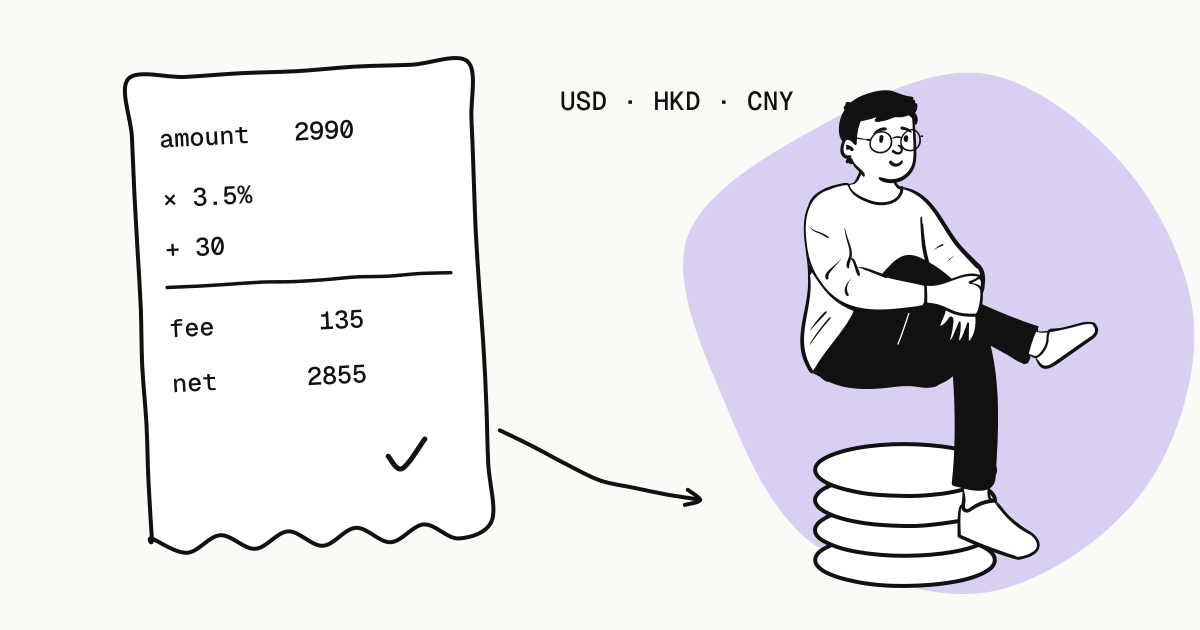
A $29.90 order paid by card:
amount      = 2990
fee         = round(2990 × 0.035 + 30) = round(134.65) = 135
net_amount  = 2990 - 135 = 2855
The merchant receives $28.55: an effective rate of about 4.5%.
A HK$50.00 order:
amount      = 5000
fee         = round(5000 × 0.035 + 235) = 410
net_amount  = 4590
An effective rate of 8.2% — the HK$2.35 fixed fee alone is almost 5 points of a HK$50 order.
A $0.20 order:
fee        = min(round(20 × 0.035 + 30), 20) = min(31, 20) = 20
net_amount = 0
When the fixed fee exceeds the order, the fee is capped at the order amount and the net is zero. The order is still marked paid and still credited; the merchant simply receives nothing for it.
The effective rate of small orders
Apply the same formula to USD orders of different sizes and the effect of the fixed fee is plain:
| Order | Fee | Net | Effective rate |
|---|---|---|---|
| $6.00 | $0.51 | $5.49 | 8.5% |
| $10.00 | $0.65 | $9.35 | 6.5% |
| $30.00 | $1.35 | $28.65 | 4.5% |
| $100.00 | $3.80 | $96.20 | 3.8% |
| $500.00 | $17.80 | $482.20 | 3.56% |
CNY orders behave the same way: the fee on a ¥9.90 order is ¥2.35, an effective rate of almost 24%; on a ¥100 order it is ¥5.50, or 5.5%.
If your average order is small, price the fixed fee in. Common answers are a higher minimum order, bundling small items, or billing quarterly or yearly instead of monthly to reduce the number of transactions.
When is the fee charged?
The fee is taken once, when the payment succeeds and is credited: the net amount goes to the available balance, and only then do fee and net_amount on the order object have values. Each order also records the rate that applied:
"fee_details": { "fee_group": "card", "fee_percent": 0.035, "fixed_fee": 30 }A later rate change never alters the fee of an order already credited, so fee_details is what to reconcile against.
What else costs money besides the transaction fee?
Refunds do not return the fee. On a full or partial refund, the buyer gets back the order amount; the original fee is not refunded.
A lost chargeback carries a fee. When a buyer files a chargeback and the merchant loses, the disputed amount is debited plus a chargeback fee, $15.00 by default; a won dispute is free. See what is a chargeback.
Payouts are charged per payout. Each payout costs a flat $5.00, with a $100.00 minimum; the amount that arrives is the payout minus $5.00, so a $1,000.00 payout arrives as $995.00. Because the fee is per payout, paying out larger amounts less often is much cheaper than frequent small payouts. See payouts.
No automatic currency conversion. USD, HKD and CNY are separate wallets: an order is credited in its own currency, and payouts are made from that currency's balance. The platform does not convert in between, so there is no hidden exchange-rate margin — but if your costs are in another currency, converting happens at your own bank.
Estimating a month
Suppose a month brings 1,000 card orders of $29.90, one chargeback lost, and a single payout at the end of the month:
| Item | Calculation | Amount |
|---|---|---|
| Sales | 1,000 × $29.90 | $29,900.00 |
| Transaction fees | 1,000 × $1.35 | −$1,350.00 |
| Chargeback (disputed amount + fee) | $29.90 + $15.00 | −$44.90 |
| Payout fee | 1 payout | −$5.00 |
| Arrives in the bank | $28,500.10 |
Total cost is about 4.7% of sales, most of it transaction fees. Average order size, chargeback rate and payout frequency are the three variables worth working on.
In the sandbox, the simulated payment tool can mark an order paid with a chosen payment method, and the sandbox balance is credited at that method's real fee group — a convenient way to test your reconciliation before going live. The full settlement rules are in fees and settlement.
Try it in the sandbox
Create a merchant account and request a test key. The sandbox needs no business verification.