Prohibited businesses: what you cannot sell through a payment provider, and why
Which businesses payment providers prohibit — gambling, crypto, adult content, drugs, weapons and more — why the lists exist, and how they are enforced.
On this page
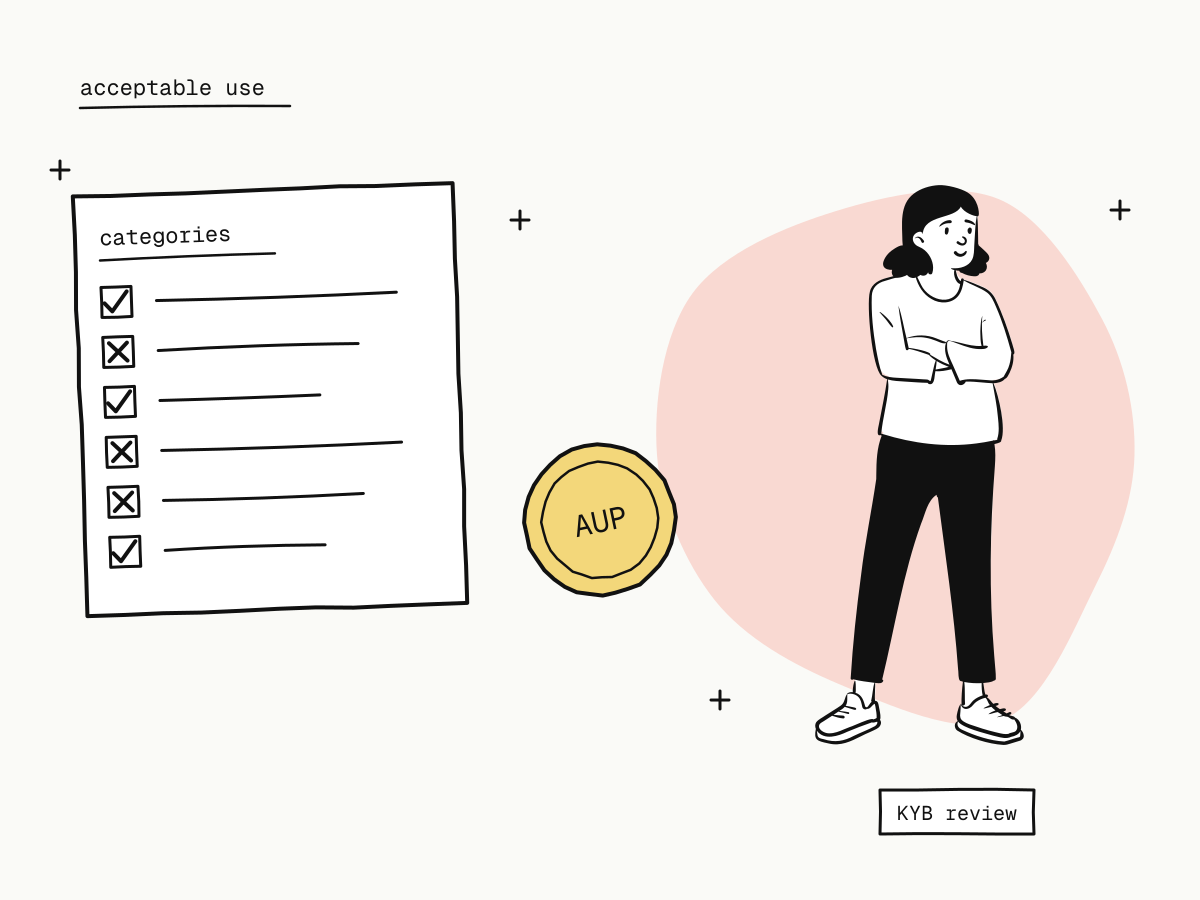
Prohibited businesses are the kinds of business a payment provider will not process payments for at all. Every provider publishes such a list, usually in an acceptable use policy, and the lists overlap heavily because they come from the same places: card network rules, the banks that settle the money, and the law. Checking your business against the list before you integrate saves you an application that cannot be approved — or an account frozen after launch.
This guide lists the businesses KukoPay prohibits, explains why payment providers restrict them, what extra limits apply to individual sellers, how the list is enforced, and what to do if you are unsure.
Which businesses are prohibited on KukoPay?
No merchant may use KukoPay to take payments for:
| Category | Examples |
|---|---|
| Gambling and lotteries | Betting, casinos, lotteries |
| Crypto and virtual assets | Crypto trading, exchanges, virtual asset sales |
| Adult content | Pornography, adult services |
| Drugs and medical devices | Medicines, medical devices |
| Weapons and ammunition | Firearms, ammunition, weapon parts |
| Tobacco and e-cigarettes | Cigarettes, vapes, e-liquids |
| Financial investment and lending | Investment products, loans, credit |
| Money transfer and collection | Remittance, collecting payments on behalf of others |
| Counterfeit and infringing goods | Fakes, pirated content, goods that infringe IP |
| Anything illegal or fraudulent | Scams, deceptive offers, illegal goods and services |
The examples are illustrative; the categories are what count. Every merchant accepts this policy when submitting their business verification.
Why payment providers prohibit businesses
- Card network and bank rules. The networks and the banks behind a payment provider decide what their payments may be used for. A provider that breaks those rules risks the processing relationship that every merchant on it depends on.
- Chargeback risk. Some categories attract disputes far above normal. A shared acquiring relationship is penalised for the chargeback rate of everyone on it, which is why KukoPay watches each merchant's chargeback rate and suspends payouts at 0.9% — see the chargeback guide.
- Licensing and law. Gambling, financial services, money transfer and medicines usually need licences in the seller's and the buyer's countries.
- Fraud and money laundering. Categories where value is easy to move or hard to verify — virtual assets, transfers, prepaid value — are where payment fraud and laundering concentrate.
Extra limits for individual sellers
If you are verified as an individual — a private person without a business licence — two more categories are not available: digital goods and virtual content, and online games. Individuals also start with cards as their only payment method and always have payment limits. See accepting international payments as an individual and payment limits explained.
How the prohibited list is enforced
- At review. Your business category and website are part of KYB verification. The website must be reachable and sell what you applied for; the category also decides your pricing and risk checks. An application that does not fit is rejected with a reason.
- After approval. A merchant found taking payments for a prohibited business has its funds frozen and its service terminated. Taking a prohibited product through an approved account under a different description is exactly this.
- Through disputes. A spike in chargebacks draws attention to what is being sold — see friendly fraud for the disputes that have nothing to do with it.
What if you are not sure your business is allowed?
- Describe the product, not the category. "A subscription to a language-learning app" is easier to assess than "digital services".
- Look at what buyers actually receive. A gift card, in-game currency or account top-up may fall under virtual assets or money transfer even when the shop sells something else.
- Ask before you build. Contact the platform with your website and a description. The sandbox needs no review, so you can integrate while you wait — see sandbox vs live mode.
- Sell in several categories? Apply for the business you actually run, and do not route a different business through the account later.
Summary
- Prohibited businesses are those a payment provider will not process for at all — on KukoPay: gambling, crypto and virtual assets, adult content, drugs and medical devices, weapons, tobacco and e-cigarettes, financial investment and lending, money transfer, counterfeit goods, and anything illegal or fraudulent;
- the lists come from card network and bank rules, chargeback risk, licensing and fraud prevention;
- individual sellers also cannot sell digital goods, virtual content or online games;
- the business is checked at verification, and a prohibited business found later means frozen funds and termination;
- if in doubt, describe your product to the platform before you go live.
Try it in the sandbox
Create a merchant account and request a test key. The sandbox needs no business verification.